
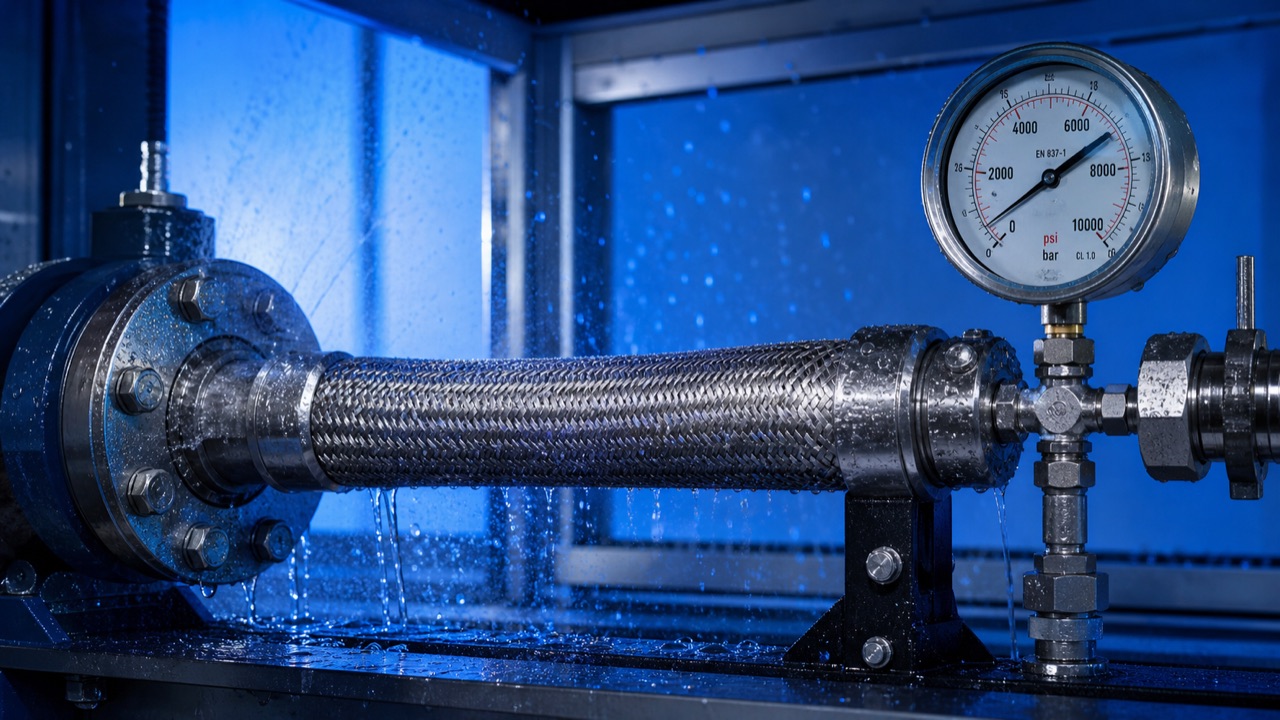
Hydrostatic testing isn't a formality — it's the difference between a hose that survives in the field and one that becomes a liability. Here is what happens inside the test tank, and why every Vigyan assembly goes through it.
Visit any hose-assembly shop and you will find two kinds: those that hydro-test every piece, and those that sample-test. The gap between them is where failures live.
What the Test Actually Does
A hydrostatic test pressurizes the assembly with water to 1.5× its rated working pressure, holds for a defined dwell time, and inspects for leakage, weeping, or distortion. Water is used instead of air because it is nearly incompressible — if something fails, the assembly releases a trickle, not a shrapnel event.
What It Catches
- Pinhole welds in the longitudinal seam or end-fitting attachment
- Under-braided or mis-aligned braid layers
- Hairline cracks from forming stress
- Incorrect end-fitting seating or crimp depth
What Sample Testing Misses
A 1-in-50 sample test confirms the batch average is good. It says nothing about the specific assembly going into a critical pump or furnace line. 100% testing is the only honest guarantee.
Our Standard
Every Vigyan hose is 100% hydro-tested, serialized, and shipped with its own test report traceable to the raw material MTC. No exceptions.