
From stainless steel strip to fully braided assembly — a behind-the-scenes look at how precision hydroforming, TIG welding, and wire braiding come together to build hoses that survive the harshest industrial environments.
Stainless steel corrugated hoses look deceptively simple from the outside, but inside each one sits a production chain of half a dozen tightly controlled processes. At Vigyan, we produce hoses in SS 304, 316, and 321 for applications ranging from LPG transfer to cryogenic nitrogen service. Here is how each hose actually gets built.
1. Strip Preparation and Longitudinal Welding
Production starts with a coil of cold-rolled stainless steel strip, typically 0.15–0.30 mm thick. The strip is slit to the exact width required for the hose diameter, roll-formed into a tube, and longitudinally welded using a plasma or TIG process shielded by pure argon. The weld bead is then rolled down to achieve a smooth inner surface — critical for corrugation uniformity downstream.
2. Hydroforming the Corrugation
The smooth welded tube is fed into a hydroforming station, where internal water pressure combined with an axial compressive force shapes the tube between forming dies into annular or helical corrugations. The corrugation geometry determines bend radius, pressure rating, and flex-cycle life — every die set is specific to a hose series (11EF, 12HF, 13MF, etc.).
3. Wire Braiding
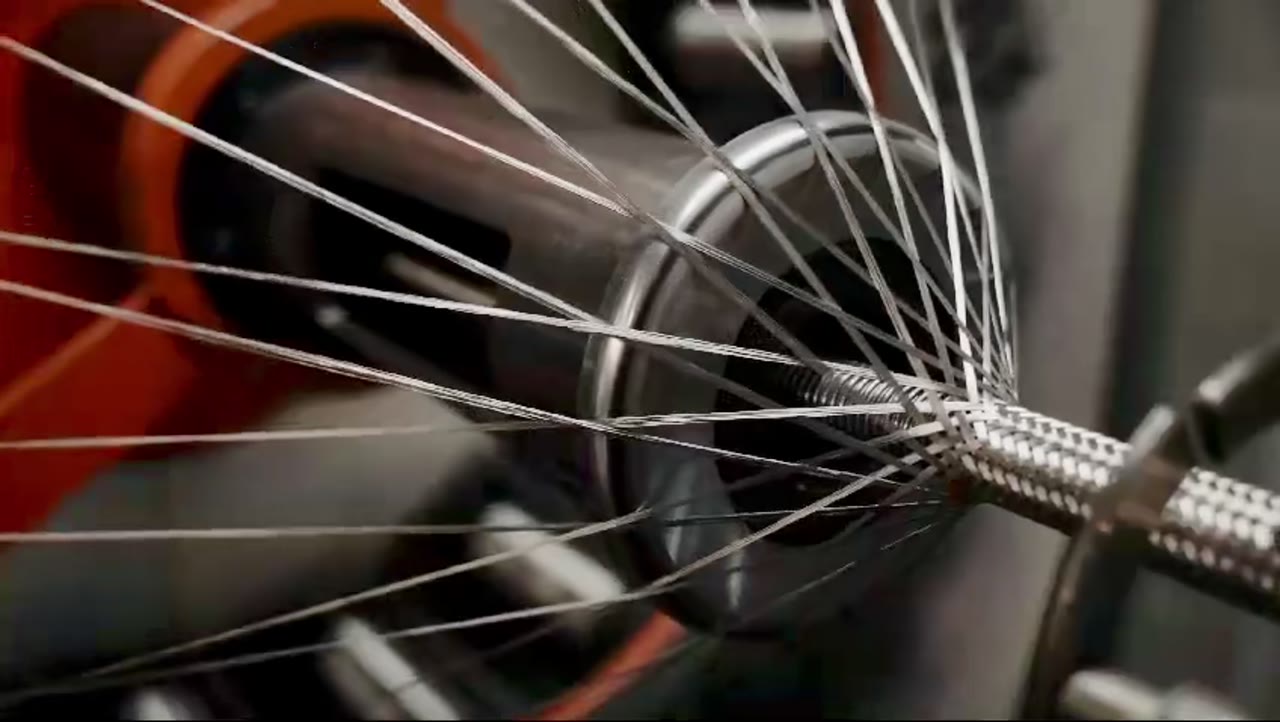
A single or double layer of 304-grade stainless wire is braided over the corrugated core on 24-, 48-, or 72-carrier braiding machines. The braid is what lets the hose contain pressure — a properly braided SS corrugated hose can hold several hundred bar depending on diameter and layer count.
4. End-Fitting Attachment
Fittings — flanges, union nuts, threaded nipples, camlocks — are TIG-welded to the braided assembly. Every weld is visually inspected and, for critical service, dye-penetrant tested before the hose moves on.
5. Hydrostatic Testing
Every single assembly is pressure-tested to 1.5× its rated working pressure, held, and inspected for any sign of seepage or distortion. Testing certificates are issued per assembly and tied to a unique serial number — full material and process traceability back to the original mill certificate.
Why It Matters
Shortcuts at any of these stages show up later as weld failures, fatigue cracks, or braid unraveling. The discipline of the process is the product — which is why every Vigyan hose carries an ISO 9001:2015-audited process trail.